
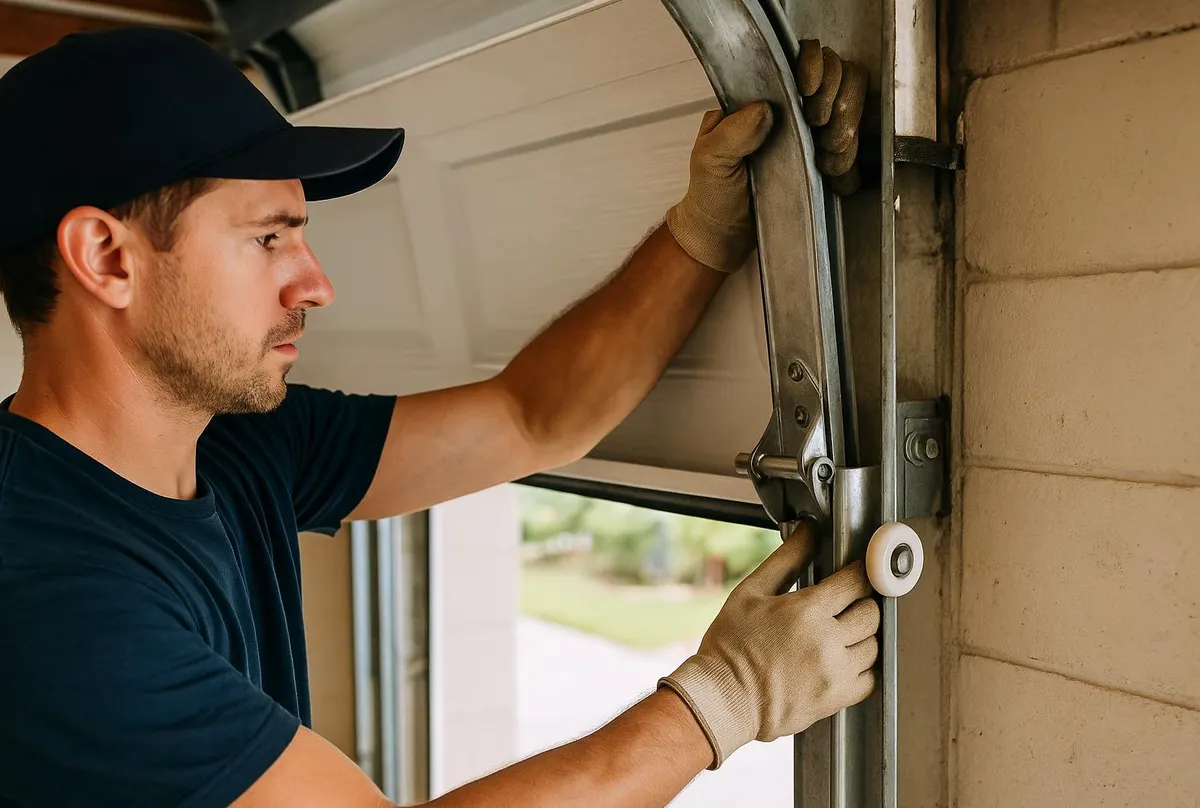
The One-Sentence Rule
Only pull the emergency release cord when the door is fully closed and resting on the ground — not when it's open, not when it's halfway through a cycle, and not when you're not sure what's holding it up.
There are exceptions. If the door is open and you know for certain the springs are intact and balanced, releasing it to move it manually is sometimes necessary — a dead opener motor during a storm, for instance. But if you have any doubt about the springs, cables, or rollers, leave the door exactly where it is and call someone instead of disconnecting it.
What the Cord Actually Does
The emergency release disconnects the door from the opener's trolley, which is what lets you lift or lower the door by hand. It exists for power outages, broken openers, and situations where you need to get a car out before the electrician or technician arrives. In Pasco County, that usually means a hurricane-season outage when the opener has no power and no battery backup, or an opener that's finally quit after years of humidity exposure.
What Goes Wrong — and How Badly
The cord disconnects the door from the opener, but it does nothing to disconnect the door from its springs. The springs are what actually hold the door's weight, not the opener. A standard residential garage door weighs somewhere between 130 and 400 pounds depending on material and size. When the springs are doing their job, that weight is balanced and the door moves smoothly by hand. When a spring is broken, stretched, or badly corroded — which happens faster here thanks to humidity and, for homes nearer the coast, salt air — that balance disappears.
Pull the release cord on a door with a broken spring and there's nothing left to hold it up. An open door can slam down with enough force to crack the slab, bend the track, or injure anyone standing underneath. A door that's even partially open and gets released can also fall in an uneven, lurching way if one cable has slipped off its drum, which puts torque on the track and knocks the door off its rails entirely.
There's a second failure mode that's less dramatic but still costly: releasing the door when the track itself is already bent or when rollers are jammed. Afternoon downpours and sudden humidity swings can cause wood or composite panels to swell slightly, and if a door was already dragging or binding before you release it, manual operation can finish the job of forcing it off track.
How to Use It Safely
- Confirm the door is down before releasing it. If it's open, use the opener (or wait for power) rather than pulling the cord with the door up in the air.
- Test the balance first, if the door is already disconnected. Lift it halfway by hand and let go. A properly balanced door stays roughly in place. If it drops or shoots upward, the springs are bad — stop and don't continue operating it manually.
- Reconnect correctly. To restore automatic operation, most openers require you to pull the cord toward the door (not just let it hang) and then run the door through one full cycle to re-engage the trolley. If it doesn't catch, don't force it.
- After a storm-related outage, check the door before reconnecting. Wind-driven rain and debris can knock a track slightly out of alignment even if the door still looks fine. Run it manually, slowly, and watch for binding at the corners before you let the opener take over again.
- Keep the cord accessible and know its location before you need it. In an actual outage at night, fumbling for the release cord in the dark is how people end up yanking it at the wrong moment.
Signs You Need a Professional Instead of the Cord
If the door won't move smoothly by hand even with the opener disconnected, if one side visibly sags lower than the other, or if you hear a loud bang before the door stopped working — that's almost always a spring failure, and it's not a DIY fix. Attempting to lift a door with a snapped spring by hand, even briefly, is one of the more common ways people get hurt with garage doors.
When to Call San Antonio Garage Door Experts
If you've pulled the release cord and the door won't stay up, moves unevenly, or came off its track, stop operating it and call us. We handle Garage Door Spring Repair for doors that have lost their balance, and Off Track Door Repair for doors that have slipped their rollers after a rough manual operation or storm event. We'll check the springs, cables, and track alignment, confirm the door meets wind-load expectations for the area, and get it back on safe, automatic operation the same day in most cases.
If your garage door in San Antonio, FL isn't behaving the way it should after a release or an outage, give San Antonio Garage Door Experts a call — we're local, we show up fast, and we'll tell you honestly what it needs.